
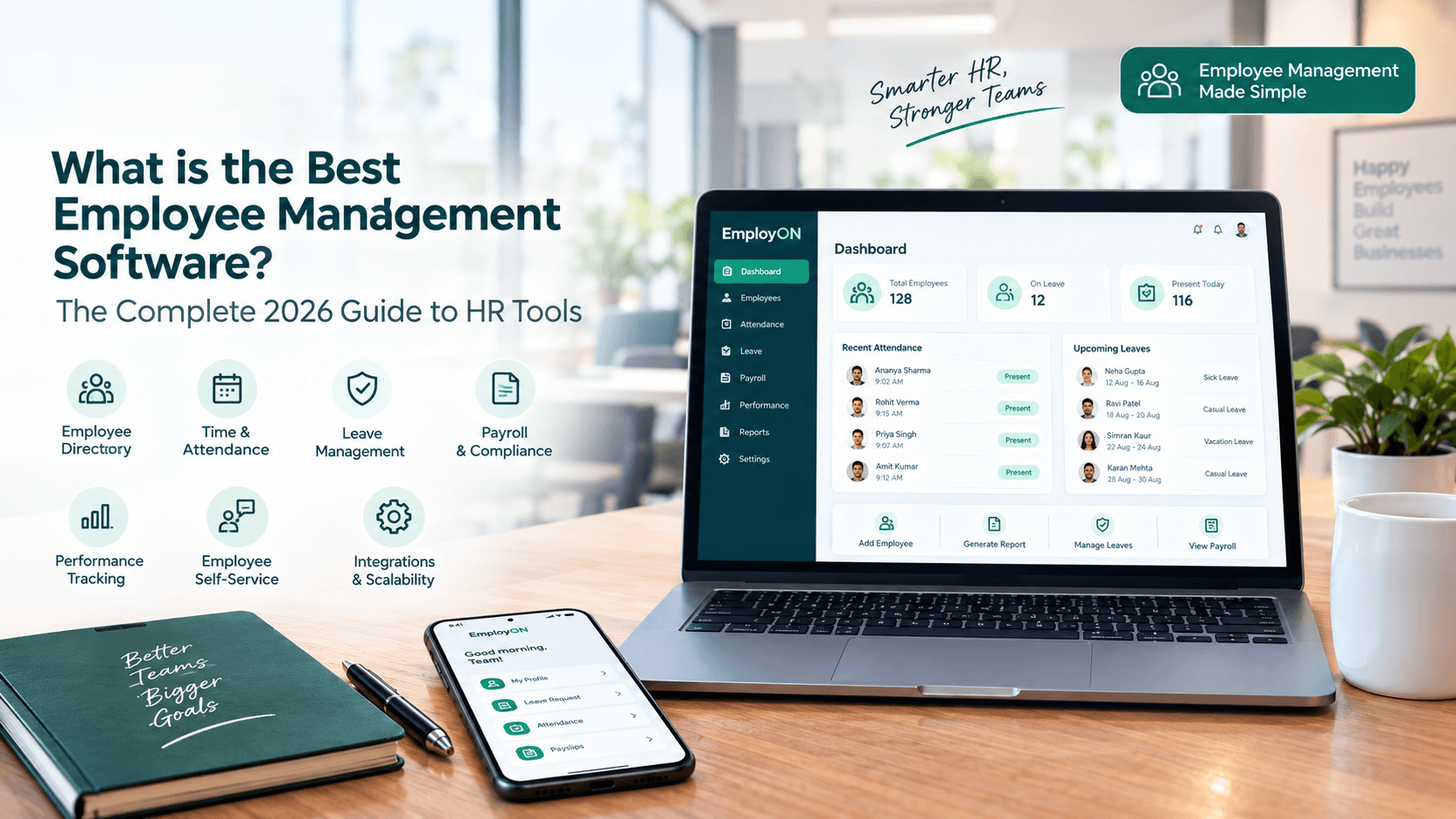
What is the Best Employee Management Software? The Complete 2026 Guide to HR Tools
Managing a modern workforce requires far more than storing resumes in a filing cabinet or tracking vacation days on a fragile spreadsheet. As businesses scale, the intersection of human resources administration, strict legal compliance, and daily operational efficiency demands a centralized digital ecosystem. When companies reach the limits of manual management, they invariably ask two fundamental questions: Which software is used in HR across the industry? and What is the best employee management software for my specific operational needs?
The HR software market in 2026 is vast and highly specialized. While large multinational corporations deploy complex, standalone Human Capital Management (HCM) systems, small and medium-sized enterprises (SMEs) face a different reality. For a growing business, HR cannot exist in a vacuum; employee data, shift schedules, and time tracking must connect directly to payroll, billing, and operational logistics.
This comprehensive guide dissects the current HR technology landscape, breaks down the core features every system must have, and explains why unified ERP-based solutions like EmployON (the dedicated HR module within the FactuON Suite) are outperforming standalone apps by turning workforce management into a competitive advantage.
Which Software is Used in HR? Categorizing the Market
Human Resources software is not a monolith. The tools a company uses depend entirely on its headcount, geographic distribution, and internal workflows. In 2026, the HR software market is generally divided into four distinct categories:
- Core HR & Administration (HRIS): These platforms function as digital filing cabinets with added workflow automation. Tools like BambooHR or Personio are widely used by small to mid-sized teams to centralize employee records, manage document storage, and handle basic onboarding without overly complicated setups. They are excellent for pure HR administration and compliance but often require third-party integrations for advanced payroll or shift scheduling.
- Enterprise Human Capital Management (HCM): Systems like Workday HCM, Oracle Fusion, or SAP SuccessFactors are designed for massive, globally distributed enterprises. These platforms manage complex, multi-national payrolls and intricate corporate hierarchies. However, they are notoriously expensive, require months of implementation, and are generally overkill for SMEs.
- Unified HR & IT Operations: Platforms like Rippling have gained traction by combining HR with IT asset management. When an employee is hired in this type of software, the system not only generates their contract but also provisions their software licenses and orders their company laptop automatically.
- ERP-Integrated Employee Management: This is the most efficient category for operational SMEs. Instead of buying an isolated HR tool, businesses use a comprehensive Enterprise Resource Planning (ERP) suite (like FactuON Suite) that includes a native HR module (EmployON). In this ecosystem, HR data feeds directly into the company’s financial, logistical, and point-of-sale modules, eliminating data silos entirely.
The 7 Non-Negotiable Features of an Employee Management System
A standalone HR database simply stores employee information; a true employee management system actively utilizes that data across all HR functions simultaneously. If you are evaluating software in 2026, ensure it includes these seven essential capabilities:
1. Centralized Employee Database
The foundation of any HR software is a single, secure repository for all employee data. This centralized database stores contact details, job roles, compensation history, and legal documents. It must feature role-based access control: managers should only see their direct reports' metrics, administrators see the entire company, and employees see only their personal files. This setup ensures compliance with strict data protection laws like the GDPR.
2. Time, Attendance, and Shift Tracking
Accurate time tracking is no longer just a payroll necessity; in many regions (such as Spain and across the EU), strict labor laws mandate the daily recording of working hours to prevent unpaid overtime. Modern software replaces punch cards with biometric integrations, web interfaces, and mobile apps featuring optional GPS geofencing for remote or field workers. Additionally, the system must include scheduling tools to plan adequate shift coverage and assign recurring shifts without spreadsheet conflicts.
3. Leave and Absence Management
Handling time-off requests via email is a primary source of administrative friction. A robust system offers a self-service portal where employees can view their available PTO (Paid Time Off) balances, submit holiday requests, and upload medical leave certificates. Managers receive instant push notifications to approve or deny requests, and the system automatically updates the team calendar and payroll deductions.
4. Seamless Payroll Integration
Payroll errors destroy employee morale and invite regulatory fines. The best employee management software eliminates the manual export and import of CSV files. When attendance data, approved leave, and compensation changes live in the same interconnected database, the payroll engine automatically calculates accurate salaries, applies statutory deductions, and generates payslips with zero manual calculation.
5. Employee Self-Service (ESS) Portals
Empowering employees to handle their own administrative tasks drastically reduces the HR department's workload. Through a 24/7 self-service portal—accessible via mobile or desktop—employees can download their payslips, update emergency contact information, review company policies, and access their tax documents without having to email HR.
6. Automated Onboarding and Offboarding
The employee lifecycle begins before the first day of work. Modern software automates the onboarding process by digitally collecting tax forms, banking details, and signed contracts before the new hire arrives. It also standardizes the offboarding process, ensuring that company assets are returned and system access is revoked securely.
7. Performance and Goal Management
To retain top talent, businesses need to track continuous development. Advanced HR modules include tools for SMART goal assignment, mid-year reviews, 360-degree feedback, and annual appraisals. Digitizing performance reviews allows managers to tie compensation revisions directly to documented achievements.
The Hidden Costs of Fragmented HR Tools (SaaS Sprawl)
A common mistake growing companies make is adopting a fragmented software approach. They purchase one app for employee clock-ins, a separate subscription for generating payroll, and a third tool for internal communication. This phenomenon, known as SaaS Sprawl, creates disastrous data silos. When an employee is promoted, HR has to manually update their salary in three different systems.
Here is a breakdown of how unified systems outperform fragmented manual processes:

EmployON: The Ultimate Employee Management Software for SMEs
When evaluating what the best employee management software is, the answer depends on how deeply you want your workforce data to integrate with your business output. For small and medium-sized enterprises (SMEs), retail chains, and operational businesses, isolated HR tools are insufficient. You need an HR system that speaks the same language as your sales, logistics, and accounting departments.
This is exactly why EmployON—the dedicated Human Resources module native to the FactuON Suite—stands out as the premier choice for modern businesses.
EmployON is not a generic HR database; it is a compliance-driven, operationally integrated powerhouse designed to solve the exact pain points of growing workforces, particularly those operating under strict European labor regulations.
1. Bulletproof Labor Compliance (Registro de Jornada)
In jurisdictions like Spain, failing to maintain meticulous daily records of employee working hours results in crippling fines from labor inspectors. EmployON handles this legal requirement automatically. Employees can securely clock in and out using the native mobile app, web browser, or integrated physical terminals at your facilities. The system automatically calculates regular hours, flags unapproved overtime, and generates legally compliant time-tracking reports ready for instant export during a labor inspection.
2. Advanced Shift Management (Cuadrantes)
If you run a retail store, a restaurant, or a logistics hub, static 9-to-5 schedules do not apply. EmployON features a highly visual shift scheduling tool. Managers can easily drag and drop shifts, build monthly quadrants, and assign coverage based on expected peak hours. Because the system tracks real-time availability, it will automatically alert managers if they attempt to schedule an employee who is on approved PTO or on medical leave, completely eliminating scheduling conflicts.
3. Secure Document Vault and Payroll Distribution
Distributing confidential payslips (nóminas) via standard email is a major data privacy risk. EmployON solves this through its secure Employee Portal. Every month, administrators can upload payroll documents in bulk. The system securely distributes the exact document to each employee's private vault. Employees receive a push notification, log into their portal, and can download their payslips, contracts, or tax certificates with full GDPR compliance.
4. The Power of Native ERP Integration
The true magic of EmployON lies in its native integration with the rest of the FactuON Suite. Because your HR module shares the same core database as your invoicing, inventory (CargoON), and point-of-sale (PosON) systems, your data becomes infinitely more valuable. When an employee clocks in via EmployON and begins processing sales in PosON, the executive dashboard can calculate the exact labor cost versus revenue generated for that specific shift in real time. You no longer have to guess your profit margins; the system calculates the exact intersection of human capital and commercial output.
Complete End-to-End Features for Total People Operations
EmployON centralizes every dimension of people management into one unified workspace, eliminating the friction of disjointed tools. Below is a complete breakdown of the platform's core capabilities:

Transparent, Scalable Pricing for Growing Businesses
Workforce management software should empower growth without imposing unpredictable licensing fees or hidden implementation costs. EmployON provides a transparent, per-seat pricing model with the flexibility of monthly billing or an annual subscription that saves up to 20%:

How to Audit Your Business and Choose the Right Platform
Selecting the right software is a critical strategic decision. If you are currently relying on spreadsheets or suffering from software fatigue due to too many disconnected apps, follow these three steps to audit your needs:
- Assess Your Operational Overlap: Ask yourself if your HR team operates in a silo. If your workforce's hours directly impact client billing, project costs, or retail coverage, you need an integrated ERP solution like FactuON, not a standalone HR app.
- Prioritize Local Compliance: Ensure the software is built to handle the specific labor laws of your country. A beautifully designed app from Silicon Valley is useless if it cannot generate the exact time-tracking export required by local labor inspectors in your region.
- Evaluate the Mobile Experience: The success of any employee management system depends on adoption. If the mobile app is clunky, employees will forget to clock in or submit leave requests incorrectly. Demand a platform with an intuitive, frictionless mobile interface for everyday staff.
The era of managing employees through fragmented spreadsheets and overflowing email inboxes is over. The best employee management software is one that treats your workforce not just as an administrative burden, but as the connected, dynamic core of your business operations. By centralizing your HR, time tracking, and compliance within a unified ecosystem like EmployON, you eliminate bureaucratic friction, protect your company from legal penalties, and empower your team to focus entirely on driving growth.