
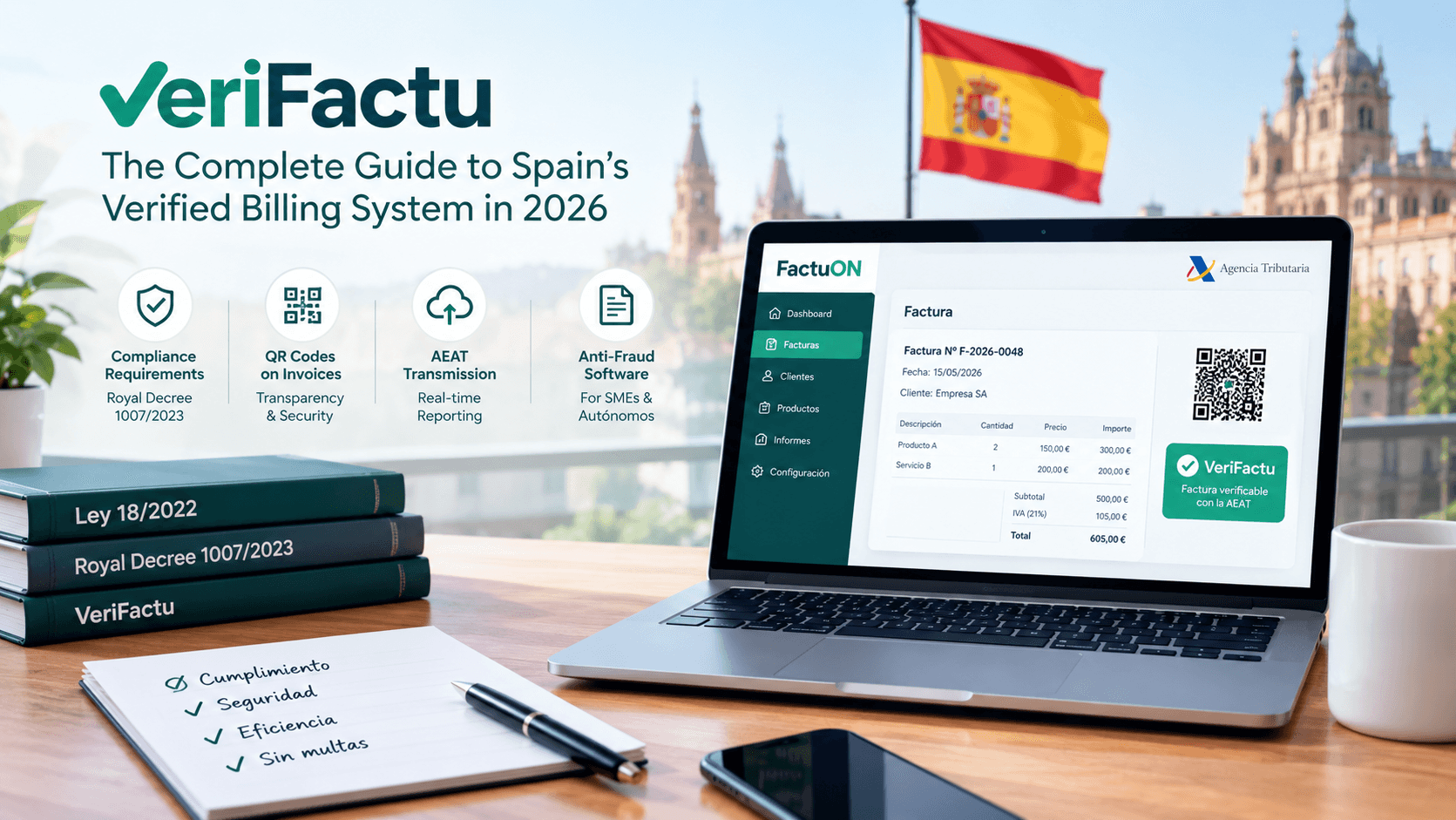
VeriFactu: The Complete Guide to Spain’s Verified Billing System in 2026
If you run a business, manage a subsidiary, or work as a self-employed professional (autónomo) in Spain, the days of issuing invoices via editable Word templates, spreadsheet formulas, or legacy desktop software have officially come to an end.
Spain has entered an era of digital tax enforcement. Driven by the Anti-Fraud Law (Ley 11/2021) and developed through Royal Decree 1007/2023, the Spanish government has introduced Veri*Factu (officially known as Sistemas de Emisión de Facturas Verificables, or Verifiable Invoice Issuance Systems).
VeriFactu is not a minor cosmetic update to your PDF layouts. It represents an overhaul of how computerized billing systems must handle data integrity, traceability, and tax reporting. From cryptographic invoice chaining to standardized tax agency QR codes, every transaction generated by your business must now leave a permanent digital footprint.
Navigating Spanish tax regulations can feel like deciphering an obstacle course of acronyms and legal decrees. This guide unpacks what the VeriFactu verified billing system in Spain is, how it operates under the hood, the severe financial penalties for ignoring it, and how modern cloud platforms like FactuON turn an intimidating legal hurdle into an automated, background workflow.
What is VeriFactu? The Legal Foundation Explained
To understand VeriFactu, you first have to understand the specific problem the Spanish Tax Agency (Agencia Estatal de Administración Tributaria, or AEAT) set out to eliminate: dual-use software (software de doble uso).
For decades, certain point-of-sale terminals and billing programs allowed unscrupulous businesses to run "double accounting" books. A merchant could ring up a transaction, print a customer receipt, and later press a hidden key sequence to erase or deflate the sale from the official accounting ledger.
The Anti-Fraud Law made developing, distributing, or simply possessing such software strictly illegal. To enforce this ban at a technical level, Royal Decree 1007/2023 established the technical specifications that all computer billing systems must satisfy.
VeriFactu refers to software systems that comply with these rules by meeting three core criteria:
- Inalterability: Once an invoice is generated, the record cannot be silently deleted, retroactively edited, or swapped. Any correction requires a formal corrective invoice (Factura Rectificativa).
- Traceability: Invoices are linked together sequentially using cryptographic hashes, creating a chain where no record can be inserted or pulled out without breaking the digital seal.
- Real-Time Verification: In its primary and intended mode, the billing software transmits an encrypted digital summary of every invoice to the AEAT immediately upon issuance.

How the VeriFactu System Works: 5 Core Technical Requirements
VeriFactu transforms your invoicing software from a passive document editor into an audited, tamper-evident ledger. The framework enforces five non-negotiable technical mechanisms across all billing software:
1. Cryptographic Record Chaining (SHA-256 Hash)
Every billing record generated by a VeriFactu-compliant program must calculate a unique digital fingerprint (using the SHA-256 hashing algorithm).
This fingerprint is built by combining:
- The tax ID (NIF) of the issuer.
- The invoice serial number and sequence number.
- The date and time of issuance.
- The total invoice amount and tax breakdown.
- The hash fingerprint of the immediately preceding invoice.
Because each invoice incorporates the cryptographic signature of the one before it, your invoices form an unbreakable chain. If an auditor or inspector inspects the database and discovers that invoice #104 does not match the chained hash inside invoice #105, it indicates that an intermediate invoice was deleted or altered.
2. Mandatory Verification QR Codes
Every invoice generated by a VeriFactu system—whether printed on paper, displayed on a screen, or downloaded as a PDF—must include a standardized QR Code alongside the official text notice: "Factura verificable en la sede electrónica de la AEAT" (Invoice verifiable on the AEAT electronic portal).
This QR code encodes a direct URL containing the key metadata of the transaction. Any recipient (a retail customer, a corporate client, or a tax officer) can scan the QR code using a standard smartphone camera. The link directs them to the official AEAT tax portal, displaying an instant confirmation verifying that the invoice was declared and matches the records stored in the government's central servers.
3. Automated System Event Logging (Registro de Eventos)
Compliant software must maintain an internal, immutable audit log. This log tracks every administrative and system event, including software startups, shutdowns, user logins, configuration adjustments, errors, and data export attempts.
These event logs must be stored securely and remain accessible to tax auditors during on-site inspections.
4. Prohibition of Silent Erasure
Under VeriFactu, software developers are legally barred from including features such as an "Edit Invoice" or "Delete Invoice" button on issued records.
If an error occurs (such as billing the wrong client, charging an incorrect VAT rate, or mistyping an amount), the correction must be executed through an official Corrective Invoice (Factura Rectificativa). This corrective invoice receives its own sequential number, explicitly references the original flawed document, and adjusts the balance upward or downward.
5. Manufacturer's Declaration of Responsibility
Software providers cannot simply claim they are compliant; they must formally certify it. Every software package or cloud platform must carry a signed, binding Declaration of Responsibility (Declaración Responsable) from the software vendor, guaranteeing that the solution meets all structural mandates of Royal Decree 1007/2023.
Veri_Factu vs. Non-Veri_Factu: The Two Operating Modes
A widespread point of confusion among business owners is that Royal Decree 1007/2023 actually outlines two paths for billing software compliance:

Option A: The "Veri*Factu" System (Continuous Transmission)
In this mode, the software sends an encrypted XML payload of the billing record to the AEAT servers the moment the invoice is finalized.
- Why it is the industry standard: Because the tax authority already holds a verified copy of the invoice, the software vendor is not required to apply an individual electronic signature to every single record.
- The practical benefit: Working in continuous transmission mode grants businesses presumption of fiscal transparency. Companies operating under Veri*Factu will experience fewer exploratory audits, streamlined tax processing, and automated pre-population of their quarterly VAT declarations (such as Modelo 303).
Option B: The "Non-Veri*Factu" System (Secure Local Custody)
A business may elect not to transmit invoices in real time. However, choosing this path does not allow you to escape the law's technical demands.
- The software must still enforce sequential hash chaining and audit logging.
- Every single invoice record must be digitally signed using a qualified corporate software certificate.
- The business must maintain the infrastructure to deliver these records to tax inspectors immediately upon request in a secure, readable format.
For 95% of small-to-medium enterprises and freelancers, opting out of automatic transmission creates unnecessary technical overhead and invites heightened regulatory scrutiny. Most modern cloud ERPs, including FactuON, operate natively in full Veri*Factu transmission mode.
Who Must Comply with VeriFactu? (And Who Is Exempt?)
The scope of the VeriFactu regulation is broad, covering virtually all economic activity in Spanish territory.
Who is Covered:
- All self-employed workers (autónomos) subject to Personal Income Tax (IRPF) on economic activities.
- All micro-enterprises, SMEs, and large corporations subject to Corporate Income Tax (Impuesto sobre Sociedades).
- Non-resident entities that operate in Spain through a permanent establishment.
- Both B2B service providers and B2C retail merchants issuing simplified invoices (cash register tickets).
Who is Exempt:
- Companies enrolled in the SII (Suministro Inmediato de Información): Large corporations (turnover > €6M), VAT groups, and companies enrolled in the monthly VAT refund registry (REDEME) already transmit their billing records to the tax authority via the SII system within 4 days. Because they are already subject to continuous digital oversight, they are exempt from VeriFactu.
- Taxpayers in the Basque Country and Navarre: The Basque historical territories (Álava, Bizkaia, and Gipuzkoa) operate under their own autonomous tax regimes. They pioneered their own verified invoicing framework known as TicketBAI / Batuz. If you are tax-resident in the Basque Country, you must comply with TicketBAI rather than VeriFactu. (Note: Platforms like FactuON provide certified compliance for both TicketBAI and VeriFactu within the same dashboard).
- Agricultural and Special VAT Regimes: Transactions explicitly exempt from general invoicing obligations under the Spanish VAT Regulations.
VeriFactu vs. Ley Crea y Crece: Untangling the Confusion
One of the most frequent misconceptions in the Spanish business community is treating VeriFactu and Ley Crea y Crece as if they were the same regulation. While they roll out concurrently, they originate from different government ministries, pursue distinct goals, and govern different transaction types.

VeriFactu (Anti-Fraud Billing)
- Focus: Tax fraud prevention and invoice integrity.
- Applies to: All invoices issued by your business, including retail till receipts, consumer sales (B2C), and corporate billings (B2B).
- Core Deliverable: Encrypted hash-chaining, AEAT QR codes on physical or digital presentations, and optional direct ledger submission.
Ley Crea y Crece (Mandatory Electronic Invoicing)
- Focus: Commercial transparency and the eradication of late commercial payments (morosidad).
- Applies to: Only business-to-business (B2B) and business-to-freelancer transactions. Sales to final consumers (B2C) are excluded.
- Core Deliverable: Invoices must be exchanged as structured computer files (XML formats such as Facturae, UBL, or EDIFACT) rather than simple visual PDFs. Furthermore, recipient companies must report payment milestones (Accepted, Payment Executed, Date of Settlement) back into the system to verify that legal payment terms (30–60 days) are met.
A complete software setup must satisfy both laws simultaneously: it must generate structured XML files that track payment states for your B2B customers, while embedding the VeriFactu cryptographic chain and QR code to satisfy the AEAT.
The Penalties: The Cost of Non-Compliance
The Spanish legislature introduced severe, automated financial sanctions into the General Tax Law (Ley General Tributaria, Article 201 bis) to ensure universal compliance.
The fines are structured around two distinct violations:
1. Fines for the Software User (The Business Owner or Freelancer)
If your business uses a billing tool that does not comply with VeriFactu standards, permits invoice deletion without audit trails, or conceals revenue:
- The standard fine is a fixed €50,000 per fiscal year in which non-compliant software was used.
- This penalty can be applied even if the tax authority does not prove deliberate tax fraud; the mere act of operating an uncertified or manipulable billing tool on your premises is sufficient grounds for the penalty.
2. Fines for Software Vendors and Developers
For programmers, software houses, or distributors that sell, license, or install non-compliant or dual-use software:
- The baseline fine is €150,000 per fiscal year for marketing uncertified systems, escalating up to €1,000 per individual license sold if the application includes deliberate mechanisms to alter records or evade taxes.
Practical Implementation: How to Prepare Your Business for VeriFactu
Adapting your company to VeriFactu does not have to be an expensive consulting ordeal if you follow a structured operational roadmap:

- Conduct a Software Audit: Contact your current software provider. Request a written copy of their official Declaración Responsable guaranteeing compliance with Royal Decree 1007/2023. If they hesitate, offer vague promises, or suggest manual workaround patches, begin evaluating new platforms immediately.
- Phase Out Manual Documents: Immediately transition any remaining manual billing workflows (Excel, Word documents, paper invoice pads) to an integrated platform.
- Establish Corrective Invoicing Protocols: Train your sales, administrative, and accounting teams on corrective procedures. Ensure they understand that mistakes can no longer be edited over; every modification requires issuing an official Factura Rectificativa.
- Verify POS Terminal Hardware: If you operate retail stores, restaurants, or trade counters, confirm that your receipt printers and point-of-sale software can print dynamic 2D QR codes cleanly and legibly on physical receipts.
- Connect Accounting and External Advisors: Ensure your verified billing data feeds directly into your accountant or fiscal advisor's software. The easiest way to achieve this is via a platform with a dedicated advisor portal.
FactuON: Built from the Ground Up for VeriFactu Compliance
Rather than attempting to bolt complex cryptographic hashing onto a decades-old legacy codebase, FactuON was designed natively around the requirements of Spain's modern fiscal framework.
FactuON provides an all-in-one cloud ERP ecosystem that neutralizes the complexity of VeriFactu, allowing you to run your business without worrying about technical tax mandates:
- Native Veri*Factu Engine: Every invoice issued through FactuON automatically calculates the SHA-256 hash chain, integrates the official AEAT QR verification code, and handles direct, secure telemetry transmission to the tax authority in milliseconds.
- Unified B2B E-Invoicing (Ley Crea y Crece): FactuON generates valid, digitally signed structured XML files (Facturae) for corporate clients while monitoring payment milestones, solving both regulatory frameworks simultaneously.
- Certified for TicketBAI and Batuz: For companies operating in the Basque Country, FactuON serves as an officially certified Software Garante, generating TBAI codes and feeding the LROE in Bizkaia without requiring third-party plugins.
- ScanON AI for Expense Management: Compliance applies to your purchases as well as your sales. FactuON's proprietary AI engine reads incoming supplier invoices, matches them against inventory receipts in CargoON, and logs your deductible VAT automatically.
- Resilient Point of Sale (PosON): Retailers and counter-service businesses can issue VeriFactu-certified receipts rapidly through touchscreens, featuring an offline mode that keeps transactions compliant even if the shop's internet connection drops.
- The Free Advisor Portal: Invite your fiscal gestor directly into your FactuON environment. Your advisor can audit tax books, download clean accounting entries, and prepare quarterly tax models (Modelos 303, 130, 115) without needing to exchange paper folders or CSV files.
Turning Regulatory Obligation into Operational Efficiency
Regulatory shifts of this scale are often met with frustration. It is easy to view VeriFactu as another bureaucratic layer imposed on Spanish businesses.
However, forward-thinking business owners recognize that modernized compliance delivers a powerful operational upside:
- Zero Lost Documentation: Real-time cloud verification means your fiscal history is secured against hardware failure, file corruption, or accidental loss.
- Faster Cash Collection: Invoices featuring clear digital verification, embedded payment links, and structured electronic delivery suffer significantly fewer dispute delays and get paid faster.
- Seamless Tax Filings: When every invoice issued and expense recorded is audited and linked in real time, the quarterly rush to balance VAT books vanishes.
- Audit Immunity: Operating through an authorized Veri*Factu pipeline establishes transparent fiscal hygiene, dramatically lowering the risk of punitive tax inspections.
The transition to verified billing in Spain is mandatory, but navigating it does not have to be painful. By replacing fragmented, manual processes with a purpose-built cloud ERP like FactuON, you protect your enterprise from crippling fines, automate your administrative overhead, and position your business for scalable growth in a modern digital economy.